In this guide
- What boron treatment is
- What it treats: woodworm and decay fungi
- Why diagnosis comes before treatment
- Where boron treatment is the right choice
- Understanding use classes
- How it is applied
- How long does boron treatment last?
- UK rules for wood preservatives
- Our timber treatment service
- Our perspective
- FAQ
- Sources
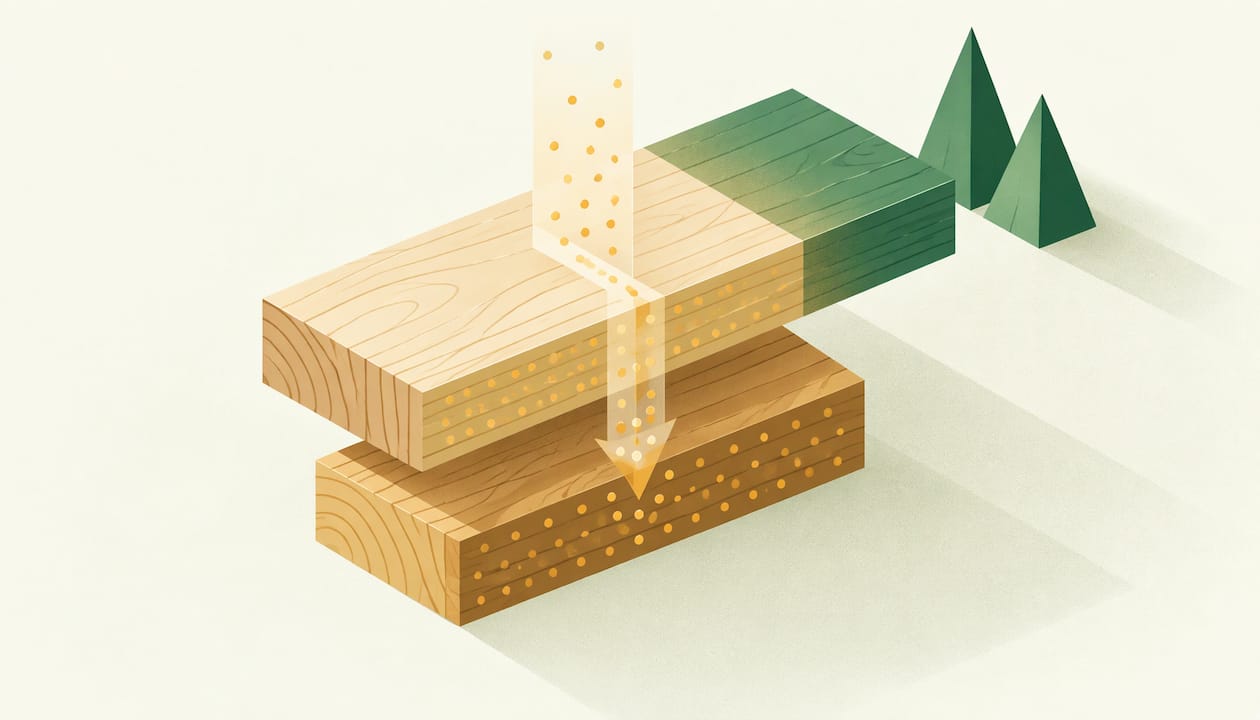
Boron treatment protects timber by putting a borate salt into the wood, where it poisons wood-boring beetles and decay fungi but has low toxicity to mammals. It works well in the right place: dry or sheltered timber that has been properly diagnosed. It works only as well as the diagnosis behind it. Borate in a joist that stays wet will not fix the leak that wets it. Our specialists survey the timber, find the moisture source and then specify the treatment, and the survey is complimentary.
Key Takeaways
- Borates (boric acid and disodium octaborate) are inorganic salts that need moisture in the wood to spread, and they then protect it against beetles and fungi.
- Published thresholds show borate acting on decay fungi in timber above about 25% moisture, and on woodworm at around 800 ppm boron.
- Borate suits dry interiors and sheltered, above-ground timber. It is not a treatment for ground contact or permanent wetting.
- In the UK, only preservatives approved under the Control of Pesticides Regulations or the biocidal products rules may be used on wood.
- The lasting fix is removing the moisture source, then treating the timber that remains.
What boron treatment is
Boron treatment uses water-soluble boron compounds as a wood preservative. The Wood Protection Association (WPA) manual lists three compounds suitable for UK use: disodium octaborate tetrahydrate, boric acid and disodium tetraborate. Disodium octaborate is the one most often used, because it carries more boron and dissolves more readily than the other two, as a technical paper on how borates protect wood explains.
The salt reaches the timber in one of three ways:
- Liquid or paste applied to bare wood, which soaks in and diffuses.
- Solid rods placed in drilled holes, which dissolve slowly when the timber is damp.
- Factory treatment of new timber before it is supplied.
Borate does not change the colour of timber. The WPA manual adds that diffusion-treated borate timber under 75 mm can be reworked after treatment, which is not true of every preservative.
What it treats: woodworm and decay fungi
Borates act on two groups of timber pests. One is wood-boring beetles, the woodworm that leave small exit holes. The other is decay fungi, the rots that soften and break down timber.
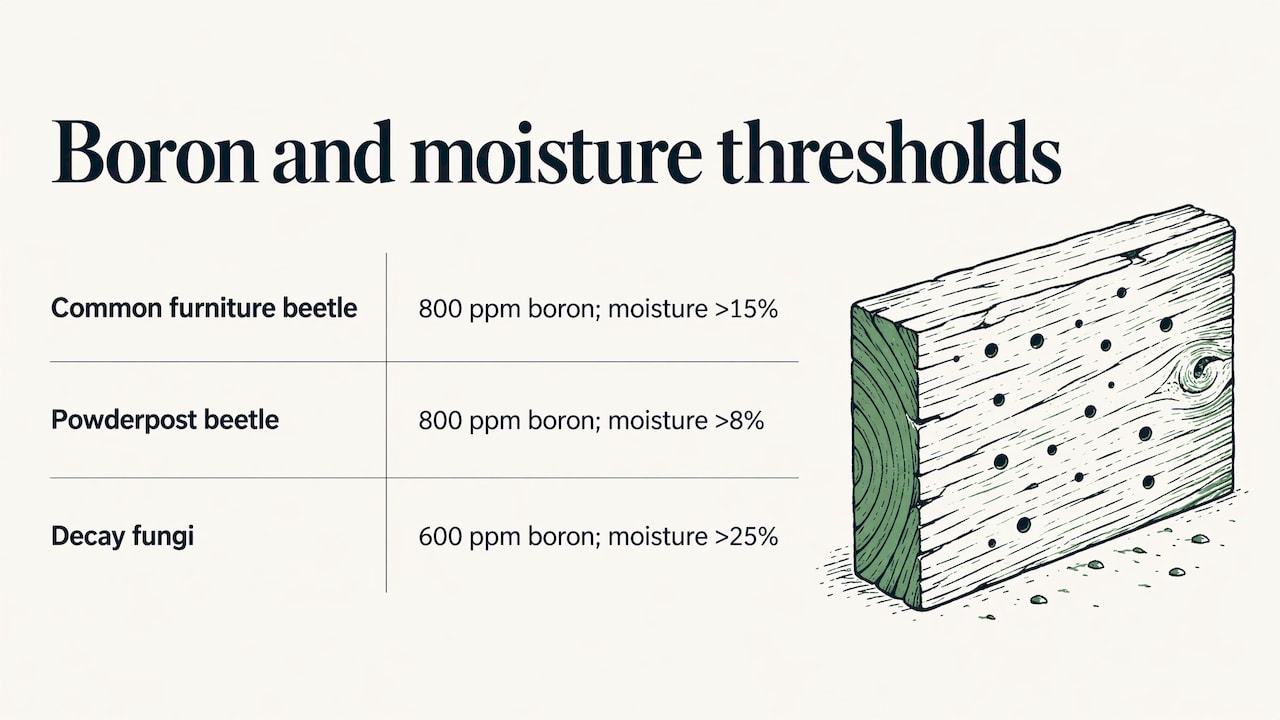
A paper on remedial timber treatment with borates gives the working thresholds. For common furniture beetle (anobiid), the timber needs a boron level of about 800 ppm and a moisture content above 15%. For powderpost (lyctid) beetle the figures are 800 ppm above 8% moisture. For decay fungi it is 600 ppm above 25% moisture. In plain terms, the borate has to reach the right depth in sufficient concentration, and it moves through the wood when the wood holds enough moisture.
That last point matters for anyone with a suspected problem. Moisture is what lets borate spread, and it is also what lets rot and beetles thrive. Dry rot and wet rot both need damp timber to start. Treating the fungus without finding why the timber is damp leaves the cause in place. Our guides to woodworm treatment and dry rot treatment in Bournemouth show how the symptoms differ and why each one begins with the source of the moisture.
One further point from the same paper: no wood-destroying insect has ever developed resistance to borates, which is one reason the treatment has stayed in use for over 75 years.
Why diagnosis comes before treatment
A preservative is a tool, not a diagnosis. Two joists with identical-looking decay can have different causes: a leaking gutter, a bridged damp-proof course, blocked sub-floor ventilation, condensation in a roof void or a plumbing leak. Each calls for a different repair, and sometimes the right answer is cutting out and replacing the failed section, then treating what remains.
The industry’s own guidance points the same way. The Property Care Association’s code of practice for remedial timber treatment calls for a suitable and sufficient risk assessment to select treatments and application methods for each job, and for contractors to follow product-label conditions.
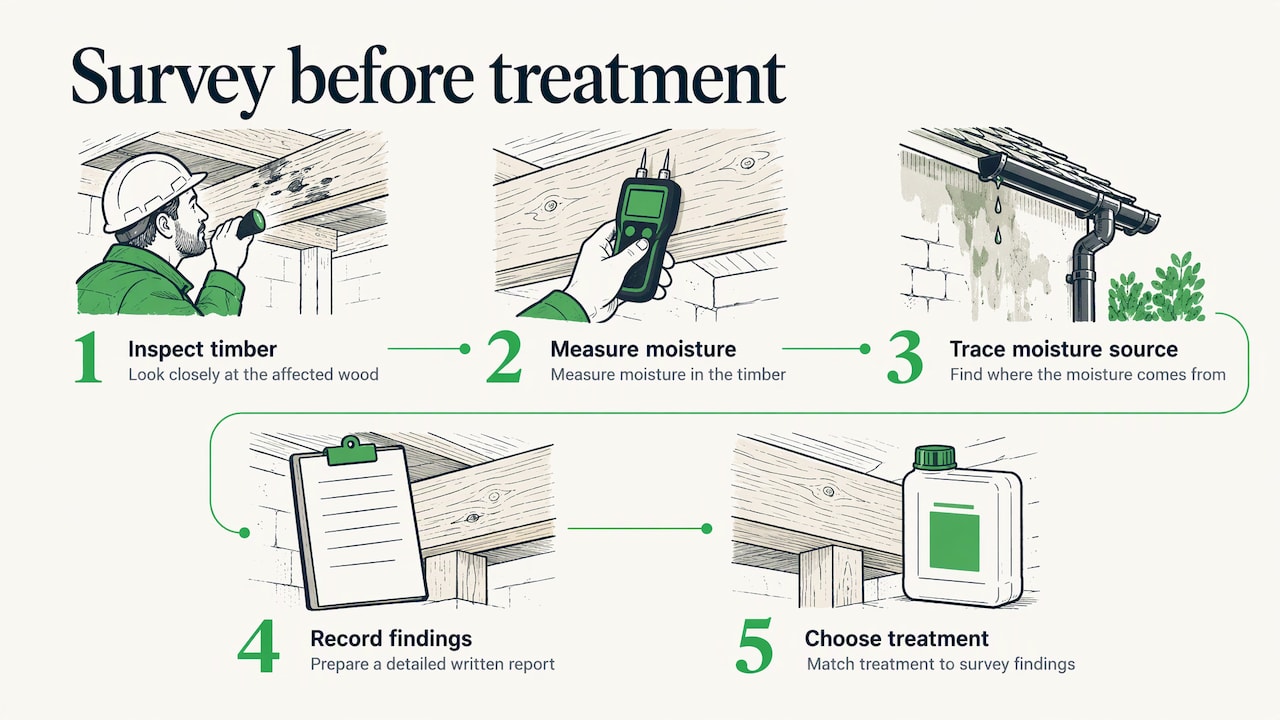
This is how our survey is built. A specialist looks at the timber, measures moisture, traces where it comes from and records what is found. You get a detailed written report. Treatment is then chosen to suit what the survey shows, rather than applied by guesswork. Our guide to how professionals diagnose timber decay goes through the process, and the signs you can check yourself help you decide when to call.
Where boron treatment is the right choice
Borates are at their best in dry interiors and in timber protected from the weather. The NSW Environment Protection Authority in Australia notes that borate-treated timber suits dry interiors and above-ground uses such as framing, flooring and joinery, and externally when it is protected from the weather. Canadian federal guidance gives the same boundary: not in contact with the ground and continuously protected from free water.
In a typical UK home, that covers the timbers most often affected:
| Timber | Typical location | Borate suitability |
|---|---|---|
| Roof timbers, rafters, purlins | Loft and roof void | Suitable, once any leak or condensation is resolved |
| Floor joists and floorboards | Sub-floor and upper floors | Suitable where the timber is dry or sheltered |
| Joinery, window frames, door frames | Internal and sheltered external | Suitable where protected from weather |
| Timber in ground contact or permanent wetting | Fence posts, buried timbers | Not a borate application |
The reason for the limit is chemical. Borate is water-soluble, so liquid water entering and leaving the wood can carry it out. Leaching requires free water moving through the timber, not simply a little moisture in the wood. Research on structural timber finds that borates do not leach under typical conditions when the wood is sheltered from rain or sealed against moisture. Sealing out the water is therefore part of the job.
Understanding use classes
Timber is graded by how much moisture it will see in service. The system is called use classes. UC1 is dry interior timber, UC2 is interior timber at risk of occasional wetting, UC3 is exterior above-ground timber, and UC4 covers ground or fresh-water contact. A guide to timber treatment classes UC1 to UC4 explains how the levels differ.
The WPA manual says boron compounds are generally restricted to Use Classes 1, 2 and 3 (coated). The WPA also advises that where a specifier is in doubt about a class, they should move up to the higher-rated category, since the consequences of failure can include shorter service life and structural safety problems. For a homeowner this means the survey should state which use class each timber falls into before a product is chosen.
How it is applied
Application depends on the timber and what the survey finds. Liquid and paste products go onto bare timber, so paint, varnish and old coatings need to be removed first. A topical borate must be applied to bare wood. Rods go into drilled holes and are sealed, and they release boron only when the timber becomes damp. Penetration is also deeper in freshly cut timber at higher moisture than in kiln-dried wood at about 9%, according to one application guide.
Coverage, spacing, drilling depth and dosage depend on the product label and the member being treated. This is where professional work earns its place: getting enough borate to the depth that matters, in the timber that matters, without missing hidden areas such as joist ends bedded in walls. Our specialists carry out the treatment themselves, with no subcontracting, so the person who diagnosed the problem is accountable for the result.
Safety around treated timber
Borate has low mammalian toxicity, but handling rules still apply. The WPA manual advises that for wet treated wood, protective gloves, footwear and an impervious apron should be worn. Once the wood is dry, occasional handling needs only hand-washing. Repeated handling calls for gloves and overalls, and sanding or machining treated wood needs efficient dust extraction under COSHH, the UK rules on hazardous substances. Keep children and pets away from timber until it has dried. These are the reasons to book trained operatives for any work in lofts and sub-floors.
How long does boron treatment last?
With borate, durability depends mainly on whether the timber stays dry. The remedial treatment paper cites up to 60 years of global experience, with protection lasting as long as the wood remains in service. It also reports that borate-treated test joints kept 60 to 84% of their original borate after five years of severe exposure with no attack, while untreated controls failed.
The same paper says losses need timber to stay wet through its full cross-section for long periods, with an outside sink for the boron to move into. A leak-free roof, working gutters, clear ventilation and a sound damp-proof course are therefore the best protection for the treatment itself.
On all of our treatment work we provide a 25-year insurance-backed guarantee, which supports the long-term view of any job.
UK rules for wood preservatives
Three points matter to a UK property owner.
- Approval. BS 8417, the British Standard on preservation of wood, states that only preservatives approved under the Control of Pesticides Regulations 1986 or authorised under the Biocidal Products Regulations 2012 may be used on wood in the UK. The standard does not cover curative (remedial) treatments, which follow the product label and industry codes.
- New build and repair work. NHBC Standards 2026 require preservatives in England, Scotland and Wales to meet the Biocidal Products (Health and Safety) (Amendment) Regulations 2022 or the Control of Pesticides Regulations 1986. They also require cut surfaces to be re-treated and timber re-dried to 22% moisture or less before it touches metal fittings.
- Service life. The WPA says brush, dip or spray products give only a degree of protection, and that 15, 30 or 60-year service lives typically need industrially pre-treated wood. Remedial work on an existing building is a different job from specifying new timber, which is why the survey should say which one applies.
When a landlord, agent or business owner needs a record for a sale, a let or a lender, a written report and an insured guarantee give that file something firm to rest on.
Our timber treatment service
Our timber treatment covers woodworm, dry rot, wet rot and timber restoration across Dorset, Hampshire and Wiltshire, including Bournemouth, Christchurch, Poole, Southampton, Winchester, Dorchester and Salisbury. The work is carried out by in-house specialists, not subcontractors, and is aligned with Property Care Association standards.
The process starts with a complimentary survey and ends with a detailed written report, then treatment chosen to fit the cause. Treatment work carries a 25-year insurance-backed guarantee.

If you suspect decay or woodworm, book the complimentary property survey. You can read more about the timber treatment service or see everything we cover on the services page.
Our perspective
Most timber problems we are called to are really moisture problems that have already done their damage. The beetle or the fungus is the visible part. The cause is a bridged damp course, a failed gutter, a blocked air brick or a roof that lets in condensation.
That is why we start with diagnosis. A borate treatment is a good, well-established preservative, and it does its best work when it goes into timber that has been surveyed, cut back where it has failed and kept dry afterwards. A specialist who has traced the cause can choose the right treatment for each timber and stand behind it.
It is also why we use our own people for the whole job. The surveyor’s findings go into the written report, the same team carries out the work, and the 25-year insurance-backed guarantee covers the treatment. For an owner, landlord or agent, that means one accountable team and a clear record of what was found and done.
Dylan
FAQ
Is boron treatment safe for a family home?
Borate is an inorganic salt with low toxicity to mammals, and its use in UK buildings is controlled under approval rules for wood preservatives. Wet treated timber should be handled with gloves and kept away from children and pets until dry. Treatment should be carried out by trained operatives who follow the product label.
Does boron treatment cure dry rot or wet rot?
Borate can stop decay fungi in timber when it reaches the required concentration, with published figures of 600 ppm boron above about 25% moisture. Fungal decay also depends on a continuing moisture source, so the damp must be traced and resolved. A survey establishes which rot is present and where the water comes from.
Will boron treatment last for decades?
Protection can last for as long as the timber stays dry or sheltered, and published experience runs to many decades. Borate is water-soluble, so persistently wet timber can lose it. Fixing leaks and ventilation is part of keeping the treatment effective, and our treatment work carries a 25-year insurance-backed guarantee.
Can I use borate on fence posts or ground-contact timber?
No. Borate is suited to dry interiors and sheltered, above-ground timber, because ground moisture can carry it out of the wood. Ground contact calls for timber treated to Use Class 4 by an industrial process.
How do I find out which treatment my timber needs?
Start with a survey. A specialist measures moisture, identifies the pest or fungus and finds the source of damp, then recommends treatment for each timber. Our survey is complimentary and ends with a detailed written report.
Sources
- Manual: Industrial Wood Preservation (WPA, 2012)
- How Borates Work to Protect Wood
- Remedial Timber Treatment with Borates
- Update on Borate Preservatives
- Remedial Timber Treatment Code of Practice (Property Care Association)
- Boron-based treated timber (NSW EPA)
- Inorganic boron (borate) environmental recommendations (Canada.ca)
- Preservative Treatments (Wood Protection Association)
- BS 8417:2011+A1:2014 (BSI Knowledge)
- NHBC Standards 2026, Chapter 3.3 Timber preservation
- Uses of Borates in Wood Treatment and Preservation
- Timber treatment classes: UC1 to UC4