In this guide
- What a thermal imaging camera actually shows
- What it cannot tell you on its own
- Conditions that decide whether the images are usable
- How to prepare for a survey
- How a thermal survey fits into a damp diagnosis
- What the report should contain
- What does a thermal imaging damp survey cost?
- When imaging is enough and when it is not
- Choosing who carries out the survey
- Our perspective
- Book a complimentary survey
- FAQ
- Sources
A thermal imaging damp survey maps surface temperatures across walls, ceilings and roofs, and flags cold or warm patches that may point to moisture. It does not measure moisture itself. The camera finds where to look, and the cause is then confirmed with a damp meter and a physical inspection. For homeowners, landlords and agents, the useful result is not a colorful image but a written diagnosis that names the source of the problem and a treatment matched to it. Proofterior provides a complimentary property survey across Dorset, Hampshire and Wiltshire that ends in exactly that: a detailed written report.
Key Takeaways
- Thermal imaging shows surface temperature, not moisture content. Damp is one of several causes of a cold patch, so findings need confirming with a damp meter.
- Results depend on conditions: a clear temperature difference between inside and outside, steady heating beforehand, and suitable weather for any external work.
- Missing insulation, air leaks and cold bridging can look like damp on an image, which is why interpretation matters more than the camera.
- A good report states observations, an impartial diagnosis, prioritized recommendations and its limits.
- Proofterior’s survey is complimentary, carried out by in-house specialists, and any treatment work carries a 25-year insurance-backed guarantee.
What a thermal imaging camera actually shows
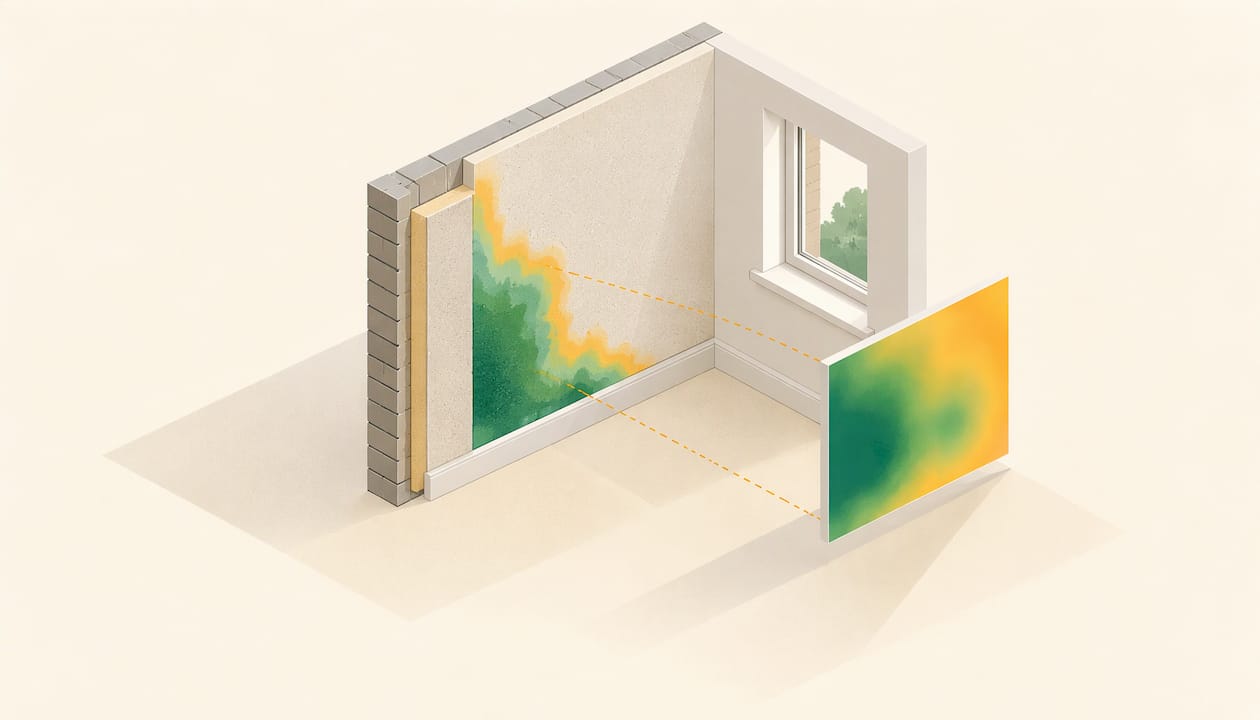
A thermal camera records infrared radiation and turns it into a picture of surface temperature. Warmer areas appear in one color, cooler areas in another. That is all it records.
Historic England’s guidance on assessing moisture explains that infrared thermography measures surface temperature, not moisture content. The reason it can still help with damp is physical: the same guidance notes that water has a higher thermal capacity than most building materials, so a wet area can behave differently from the dry fabric around it. Evaporation from a wet surface also cools it.
The RICS (the Royal Institution of Chartered Surveyors) describes the method as anomaly detection. In its introduction to building thermography, thermal images reveal patterns, damp is one possible cause of a cold area, and suspected damp should be confirmed with a damp meter. A cold patch is a question, not an answer.
What it is good at
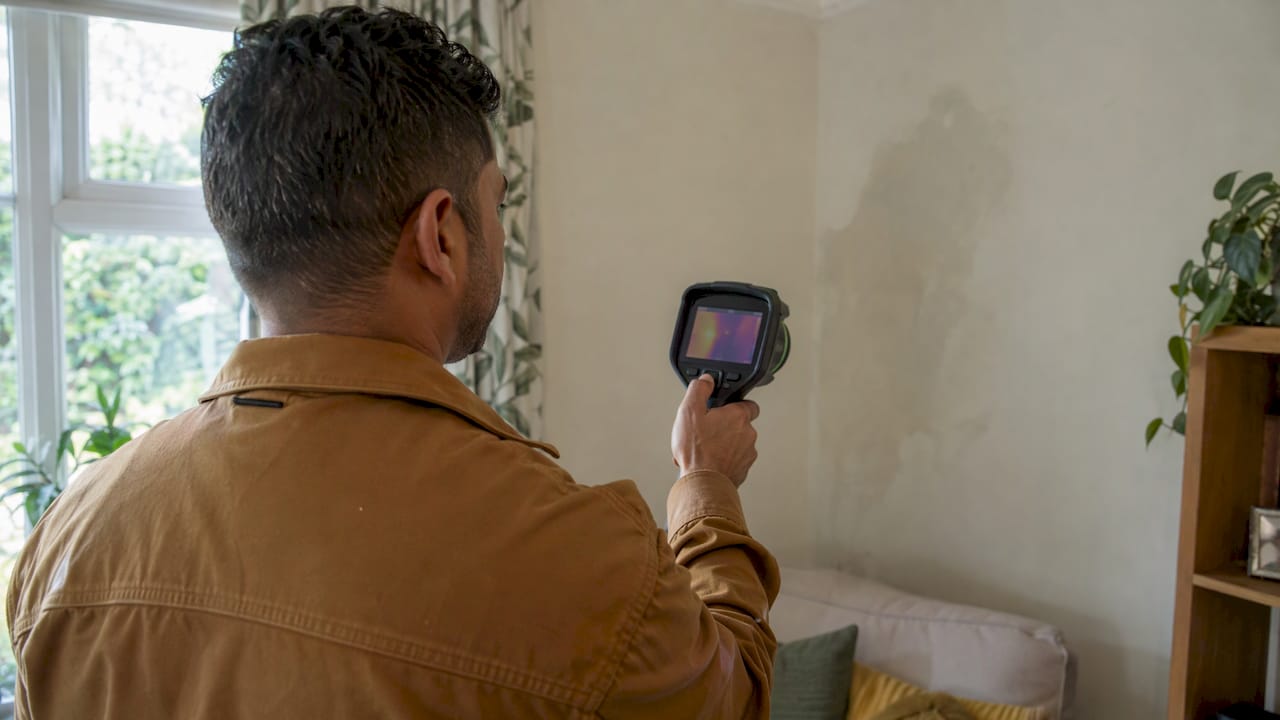
Used well, thermal imaging is a quick, non-destructive way to scan a large area. The UK Thermography Association’s building thermography guide describes it as useful for locating possible structural damp and leaks in roofs, walls, floors, windows and doors. RICS adds that it can identify anomalies linked to damp ingress, cold bridging, air infiltration and missing insulation.
Typical uses on a damp job include:
- Tracing the likely path of a roof or gutter leak before opening up a ceiling.
- Spotting cold areas on external walls that may be linked to condensation or mould growth.
- Locating the pattern of a leaking pipe under a floor or behind plasterboard.
- Showing where insulation is missing or has slumped, which explains cold walls and surface condensation.
What it cannot tell you on its own
The main limit is that different causes produce similar images. Historic England warns that background knowledge is essential because missing insulation and air leakage can mimic moisture patterns. A cold, blue patch on a bedroom wall could be:
- Penetrating damp from a defective gutter, render or pointing.
- A cold bridge, such as a concrete lintel or a poorly insulated corner.
- Condensation forming on a surface that is cooler than the room air.
- A gap in insulation or an air leak behind the plasterboard.
Each of these needs a different fix. Treating a cold bridge as rising damp, or an insulation gap as a roof leak, wastes money and leaves the problem in place. RICS and the UKTA both say the same thing in different words: imaging localizes likely anomalies, and other instruments establish whether moisture is really present.
That is why the 2022 joint statement from RICS, Historic England and the Property Care Association on investigating moisture in traditional buildings lists thermal imaging alongside hygrometers, thermometers, moisture meters and atmospheric data loggers. It is one tool among several, and the practitioner is expected to understand all of them.
Conditions that decide whether the images are usable
A thermal survey done in the wrong conditions produces images that look dramatic and mean little. Four factors matter.
Temperature difference
RICS recommends a minimum 10°C difference between indoor and outdoor temperature for building thermography, and notes that UK conditions are generally suitable in the colder season. This is why thermal surveys cluster in autumn and winter, and why a mild, humid day in spring or summer is a poor time for one.
Time of day and sun
The same RICS article says external thermography should not be done in daytime, because solar heating can obscure anomalies. Walls that have been warmed by the sun release heat unevenly for hours afterward, hiding the pattern you want to see.
Rain and wind
Rain and medium-to-strong wind cool surfaces and mask anomalies. RICS gives a firm limit: wind above 5 m/s makes an external inspection pointless, while light wind may be acceptable if measured with an anemometer. On the Dorset and Hampshire coast, where wind is a frequent factor, that can rule out a surprising number of days.
Heating and building state
Internal surveys need the building to be in a steady thermal state. The next section covers how to prepare.
How to prepare for a survey
RICS gives a client checklist for internal thermography. Following it makes the images more reliable, whoever carries out the survey:
- Keep indoor temperature steady at 20 to 22°C for at least 72 hours beforehand.
- Clear furniture, curtains and stored items from the internal faces of external walls.
- Leave internal doors open.
- Keep windows and external doors shut.
For landlords, this means arranging the heating with tenants before the visit. For agents, it means checking that a vacant property has been heated for long enough, not just switched on that morning. A cold, unheated house will show broad cold areas everywhere and reveal very little.
Also gather the history. Note where stains, peeling paint, musty smells or mould appear, when they appeared, and whether they worsen after rain or during cold snaps. Pattern and timing often separate penetrating damp from condensation before any instrument is used.
How a thermal survey fits into a damp diagnosis
The sequence a competent survey follows is consistent across the guidance:
- Scan. Thermal images identify anomalies across walls, ceilings, roofs and floors.
- Consider causes. The surveyor weighs the building’s age, construction, orientation, heating and ventilation against the image.
- Confirm. A damp meter and other checks establish whether moisture is present and at what level. The moisture mapping process is one way these readings are recorded across a property.
- Diagnose. The cause is named: rising damp, penetrating damp, condensation, a leak, or a combination.
- Report and recommend. Findings and options are set out in writing.
The point of the sequence is that the treatment follows the cause. If the cause is condensation, the answer is usually ventilation and insulation, not injection. If it is a failed roof valley or chimney flashing, the answer is a roof repair, not internal treatment. Two of our case studies show this in practice: a chimney leak and damp fix in Southampton and a cottage in Sturminster Newton where the water entered through chimney and render, not through the ground.
What the report should contain
A thermal image pasted into a PDF is not a report. The 2022 joint statement from RICS, Historic England and the Property Care Association says a professional report should:
- Summarize observations and their significance.
- Provide an impartial diagnosis.
- Explain and prioritize recommendations.
- State relevant limitations and exclusions.
It also says that where repair options are given, they should explain advantages, disadvantages, and relevant cost and time implications, and that conflicts of interest should be stated. Use that list as a yardstick for any survey you commission, whether for your own home, a rental portfolio or a sale.
What does a thermal imaging damp survey cost?
Prices vary widely because the work varies. Fees depend on the size and type of property, the scope (a single wall, a whole house or a roof), access and preparation, travel, the depth of the written analysis, and the conditions needed to capture usable data. Analysis and reporting take time on top of the visit itself, which is why a stand-alone thermal survey is rarely the cheapest part of an investigation.
For a homeowner whose real question is “where is this damp coming from and how do I stop it?”, paying separately for imaging, then for a damp inspection, then for a quote, adds steps without adding certainty. Proofterior’s survey is complimentary, and it is built around finding the root cause. For a landlord with several properties, or an agent with a sale pending, that removes one fee and one delay from the process.
When imaging is enough and when it is not
| Situation | Thermal imaging alone | What else is needed |
|---|---|---|
| Tracing a suspected roof leak over a ceiling | Useful for locating the likely area | Inspection of the roof, valleys, flashings and chimney |
| Cold, mouldy corners in a bedroom | Shows cold surfaces | Humidity and ventilation assessment, and a check for damp |
| Tide mark on a ground-floor wall | Limited | Moisture readings and inspection of ground levels and any existing damp proof course |
| Pre-purchase concern about a house | Can flag areas of concern | Full damp survey and written findings; see our guide on whether you need a damp survey before buying |
| Both damp and mould visible | Shows patterns | Decide which problem comes first; see damp survey vs mould survey |
The pattern is clear: imaging helps you ask better questions, and a diagnosis answers them.
Choosing who carries out the survey
For damp work, the surveyor and the contractor should ideally work to the same standard, so the diagnosis and the treatment fit together. Look for a firm that works to Property Care Association standards, produces a written report to the structure described above, and uses its own staff rather than subcontractors for the work it recommends. Our checklist for choosing a damp contractor sets out the questions to ask, and our guide to what a damp survey is explains the basics.
Our perspective
Thermal imaging is a good way to see where a building behaves differently. We treat what it shows as a starting point, because a cold patch has several possible causes and each one needs a different remedy.
That is why our approach centers on finding the root cause before recommending any treatment. Our specialists are in-house, not subcontractors, so the person who diagnoses the problem is part of the team that puts it right. The survey is complimentary, and it ends in a detailed written report so the reasoning is on paper.
Our work is PCA aligned and accredited, and every treatment we carry out comes with a 25-year insurance-backed guarantee. For homeowners, landlords and agents in Dorset, Hampshire and Wiltshire, that means a diagnosis you can read, a treatment matched to it, and cover that lasts.
Dylan
Book a complimentary survey
If you have a cold, stained or mouldy wall and want to know why, the next step is a survey that ends in a named cause and a written plan. Proofterior covers Bournemouth, Christchurch and Poole, Southampton, Winchester, Dorchester, Salisbury, Fordingbridge and the surrounding areas. See what happens in a complimentary damp survey, then arrange yours.

The Complimentary Property Survey covers damp, timber and the wider condition of the property. If the findings call for work, our damp proofing, mould, timber, roofing and ventilation services are all delivered by the same in-house team.
FAQ
Can a thermal imaging camera detect damp?
It can show areas that are cooler or warmer than their surroundings, and damp is one possible cause. It does not measure moisture content, so suspected damp is confirmed with a damp meter and an inspection of the building.
When is the best time of year for a thermal imaging survey?
The colder season, when there is a difference of at least 10°C between inside and outside. RICS says UK conditions are generally suitable then. External work should be done outside daytime sun and in calm, dry weather.
Will a thermal survey show mould?
It can show cold surfaces where condensation and mould tend to form, but it does not identify mould itself. Mould is identified by inspection, and the underlying moisture or ventilation cause then has to be addressed. Our mould removal and air quality service deals with both.
Do I need thermal imaging if I already have visible damp?
Not necessarily. Visible damp calls for a diagnosis of its cause, and imaging is only one way of supporting that. A complimentary survey with a written report is the practical starting point.
Sources
- An introduction to building thermography, RICS
- Conducting a successful thermographic survey, RICS
- Assessing moisture in porous building materials, Historic England
- Investigation of moisture and its effects on traditional buildings, joint position statement
- Building Thermography, UK Thermography Association