
What Happens During a Free Damp Survey? Here Is Exactly What to Expect
If you have noticed damp patches, mould, or a persistent musty smell in your property and are considering booking a free survey, the most common question is a reasonable one: is this actually a professional inspection, or is it a sales visit dressed up as a survey?
With Proofterior, it is a full professional inspection. An ISSE-accredited surveyor visits your property, carries out a systematic diagnostic assessment using calibrated equipment, and produces a written report with findings and a fixed quote. You are under no obligation to proceed with any treatment. The survey is free regardless of the outcome.
Here is exactly what happens from the moment the surveyor arrives.
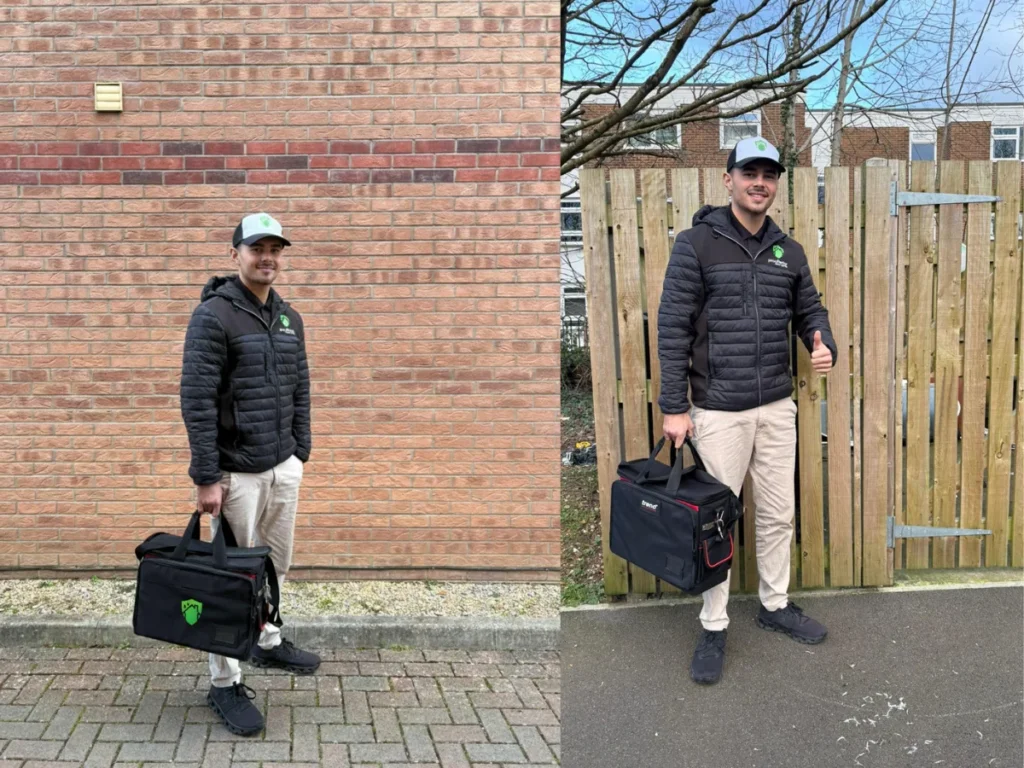
On arrival: The initial walkthrough
The surveyor begins with a conversation. Before any equipment comes out, they want to understand what you have noticed, when you first noticed it, and whether anything has changed. This context matters. A damp patch that has been there for years tells a different story from one that appeared after a period of heavy rain. A smell that is worst in one room, or marks that appear only in winter, are all diagnostic information before the inspection has formally begun.
From there, the surveyor carries out a walkthrough of the whole property, not just the room where symptoms are visible. This is important. Damp rarely stays where it enters. Moisture can travel through walls, along joists, and through the building fabric before showing up on an internal surface. A problem visible in a first-floor bedroom may have its origin in a blocked gutter or failed flashing outside. A damp patch at the base of a ground floor wall may be connected to ground conditions on the other side of the building. Starting with the full picture is what makes the subsequent targeted inspection reliable.
The inspection: what the surveyor does and why
Once the walkthrough is complete, the detailed inspection begins. Proofterior surveyors use a standard set of diagnostic tools on every survey, selecting additional techniques where the findings warrant them
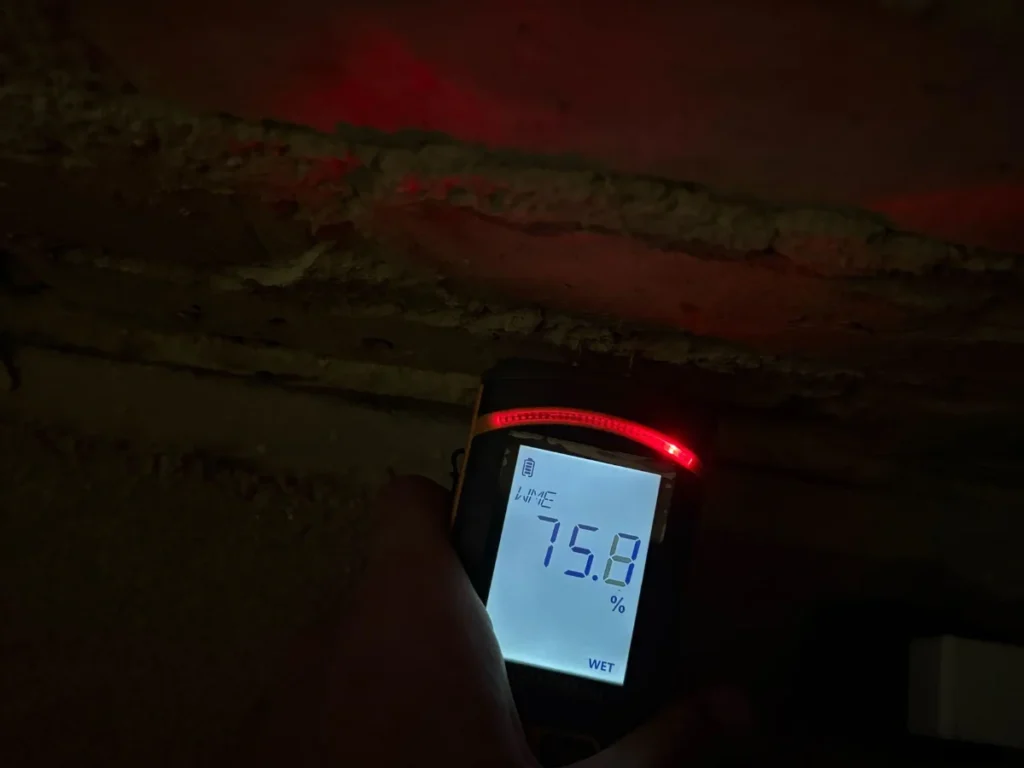
Moisture meter readings.
Calibrated moisture meters are pressed against walls, floors, and ceilings in and around the affected areas. The surveyor takes multiple readings at different heights across each wall, building a moisture profile rather than a single data point. That profile is what tells the story. Rising damp produces readings that are highest at the base and decrease with height, reflecting the way groundwater moves upward through the masonry by capillary action. Penetrating damp produces localised elevated readings that correlate with an external defect. Condensation typically affects the surface layer without generating the deeper sub-surface moisture that structural damp creates. Without a systematic series of readings, it is not possible to distinguish between them reliably.
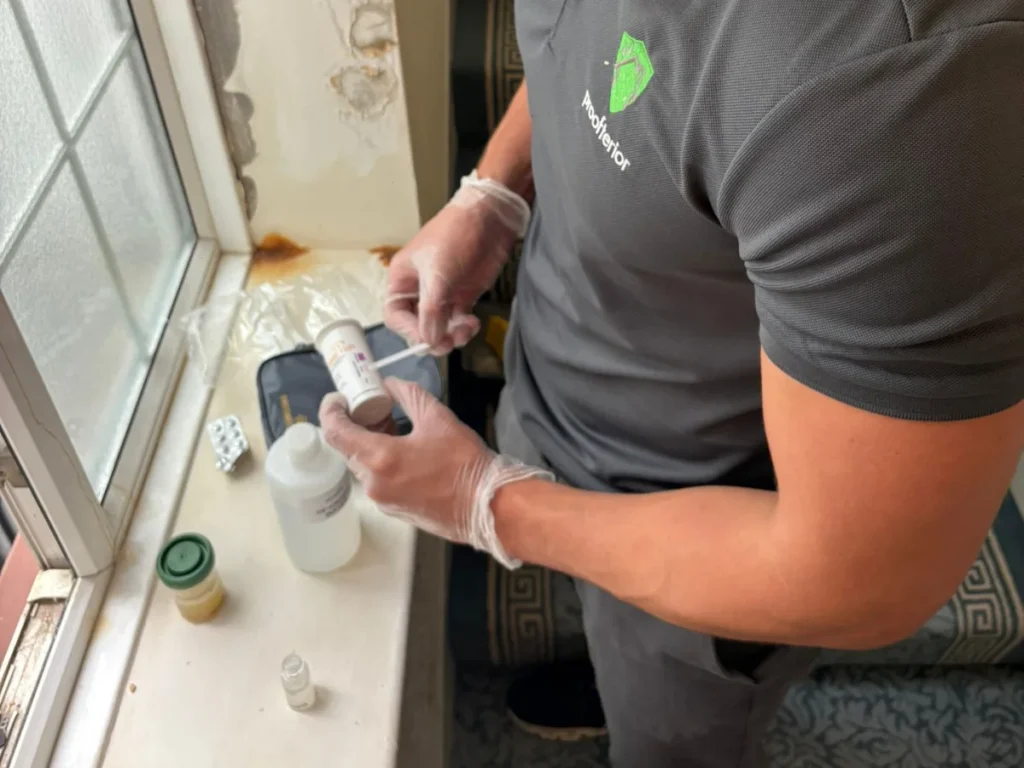
Salt analysis.
Where the moisture pattern or visual evidence suggests rising damp, the surveyor tests the plaster for hygroscopic salts. These are nitrates and chlorides carried up through the wall by groundwater and deposited in the plaster as the water evaporates. Their presence in the plaster is a strong indicator that the moisture source is from below. It also matters for treatment planning: hygroscopic salts continue to attract moisture from the air even after a damp proof course has been reinstated, which is why salt treatment and replastering with a salt-resistant backing coat are essential components of any proper rising damp treatment. The salt analysis confirms whether that stage is needed
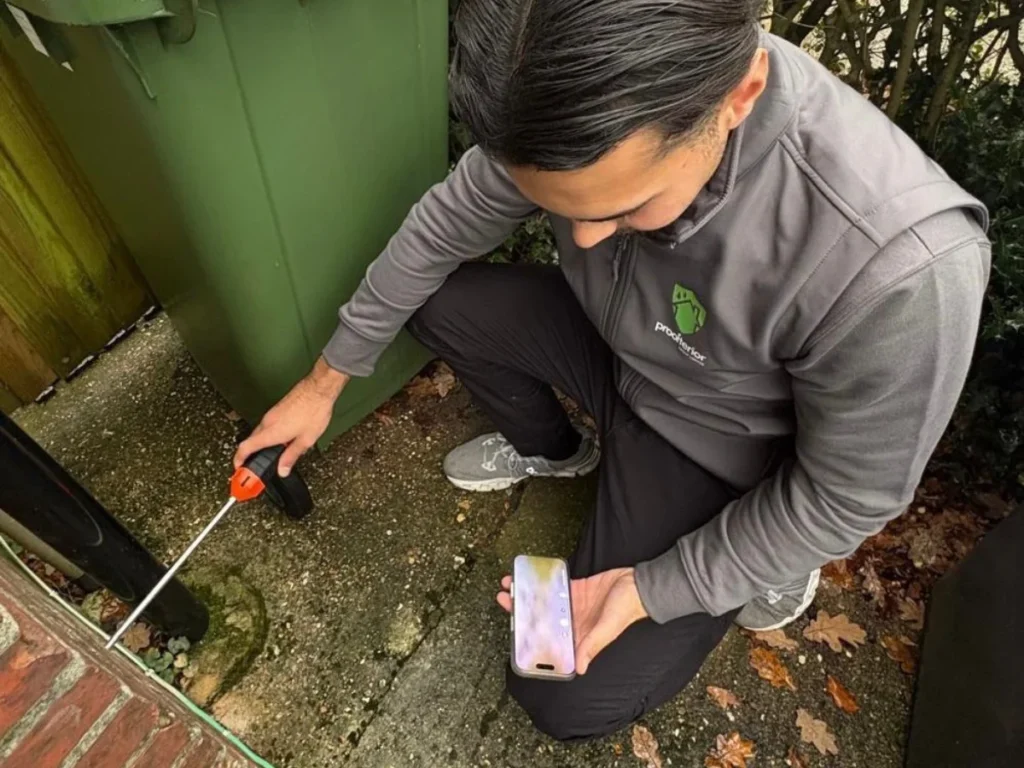
Visual inspection of walls, floors, timbers, and external masonry.
The surveyor examines wall surfaces for the physical signs of each moisture type: tidemarks and salt deposits at the base of walls for rising damp; spreading wet patches that track from windows, roof lines, or external defects for penetrating damp; black mould in corners, on cold surfaces, and behind furniture for condensation. Skirting boards, floor timbers, and any exposed structural timber are checked for signs of moisture absorption, softening, or early decay. Timber adjacent to persistent damp can deteriorate without producing obvious visible signs on the surface.
Externally, the surveyor checks the condition of the masonry, render, pointing, window seals, gutters, downpipes, and any visible roof details. Many penetrating damp problems have a straightforward external cause: a blocked gutter saturating a wall below it, a section of failed pointing giving rainwater a direct channel into the masonry, or a cracked render line above a window. Identifying the external source is what allows the treatment to address the problem rather than just the symptoms.
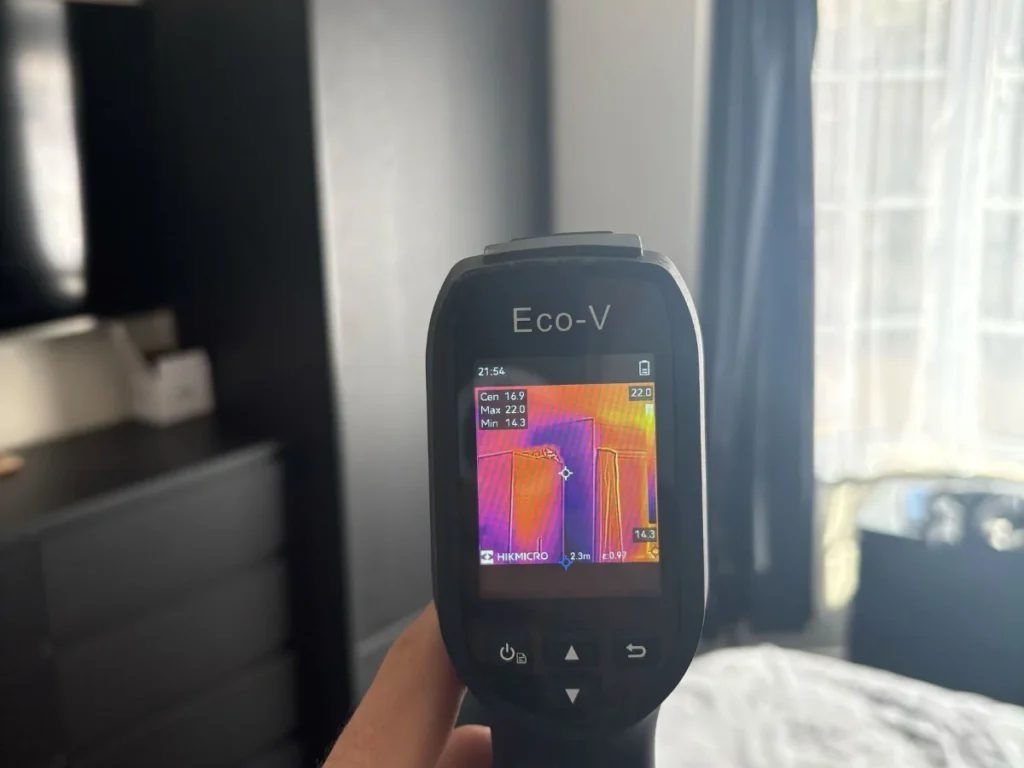
Humidity and ventilation assessment.
In rooms where condensation is suspected, the surveyor assesses the ambient humidity and the property’s ventilation profile. Persistent humidity above 70% creates conditions where moisture will settle on cold surfaces. Rooms with no mechanical ventilation, poor air circulation, or cold spots caused by thermal bridging are the most vulnerable. Understanding the ventilation pattern across the property allows the surveyor to recommend the right solution, whether that is a targeted ventilation upgrade or a broader approach for properties with persistent condensation across multiple rooms.
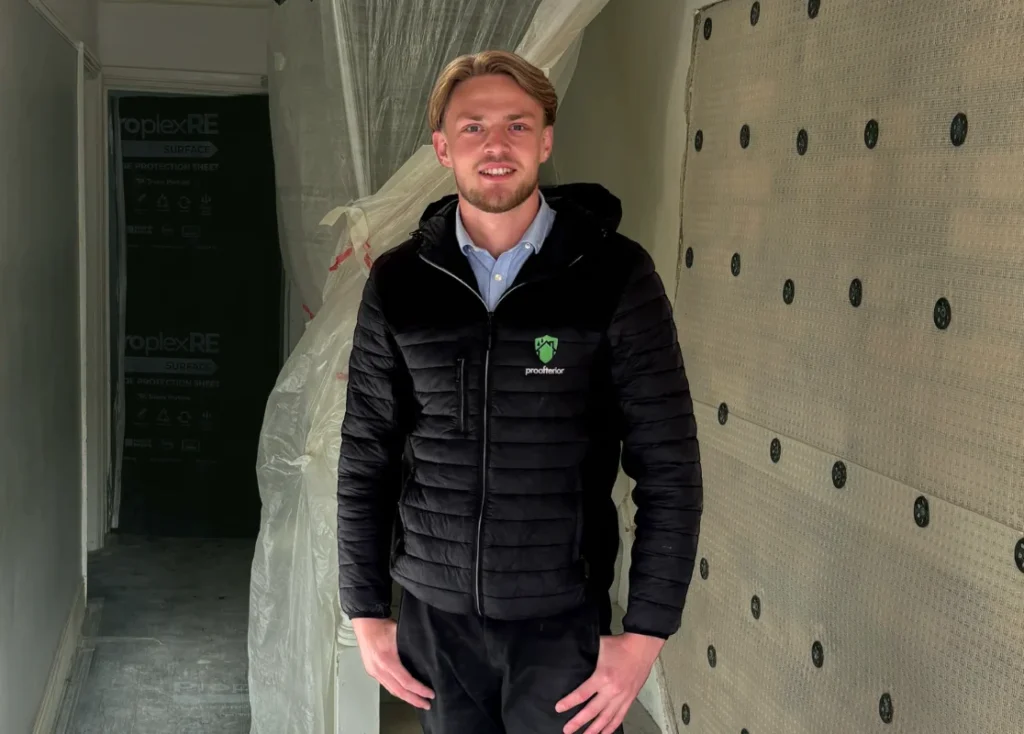
The findings conversation
Before leaving, the surveyor explains what was found in plain terms. You will know what type of moisture problem is present, where it is coming from, and what the likely scope of treatment involves. There are no technical reports handed over at the door. The surveyor talks you through the findings, gives you the chance to ask questions, and makes sure you have a clear picture of what has been diagnosed before they leave.
If nothing of concern is found, that is what the surveyor tells you. A Proofterior survey is not structured to recommend treatment regardless of the findings. The value of an honest diagnosis is that it gives you a reliable basis for the decisions you make about your property.

The written report
The full written report is delivered within 24 hours of the survey. It contains the surveyor’s findings in detail, with photographic evidence of all significant observations, the moisture readings recorded during the inspection, the diagnosed type and source of moisture, and the recommended treatment where one is needed.
Where treatment is recommended, the report includes a fixed quote for the full scope of work. Fixed means fixed. Not an estimate subject to revision once work begins. The quote specifies exactly what will be done, what materials will be used, and what the cost will be, so you can make an informed decision without any ambiguity.
The report is also the document you may need for other purposes. If you are in the process of selling the property, the survey report and any associated treatment guarantee provide the documented evidence solicitors and buyers’ surveyors want to see. If you are a landlord managing a property affected by damp or mould, the written report and its findings are your baseline record of the property’s condition and the steps taken to address it.

What happens next: no obligation
Receiving the report does not commit you to anything. You are free to take the findings away, consider the quote, compare it with others, and make the decision that is right for you. Proofterior does not use the free survey as a mechanism to apply pressure. The survey stands on its own as a professional service.
If you decide to proceed with treatment, Proofterior will contact you to schedule the work at a time that suits you. The same in-house team that carried out the survey is connected to the technicians who carry out the treatment. No job is subcontracted. The accountability runs from the initial diagnosis through to the completed work, and every treatment carries a 25-year guarantee.
If you decide not to proceed, or if the survey finds no problem requiring treatment, no further action is needed on your part.
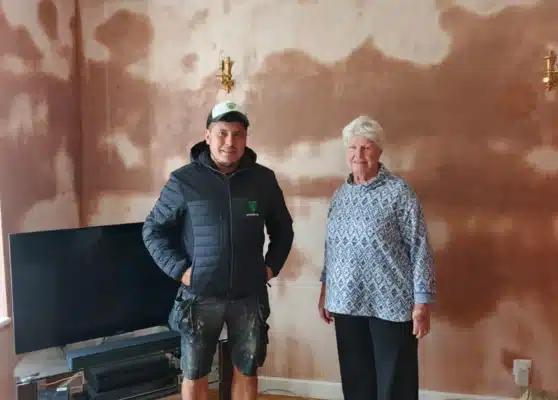
Who can book a free survey?
Proofterior’s free damp surveys are available to homeowners, landlords, and property managers across Dorset, Hampshire, and Wiltshire. The survey is available regardless of the age or type of property, and is equally relevant to a Victorian terrace in Bournemouth, a rural farmhouse in Wiltshire, a rental property in Southampton, or a period cottage in the Dorset countryside.
If you are a landlord dealing with a tenant report of damp or mould, a free survey provides a professional assessment of what is present, what is causing it, and what it will take to resolve it. That assessment is your documented starting point for any remediation work and your evidence of having taken the problem seriously.
To book, call 01202 287 503 or email info@proofterior.com. The 24-hour contact line means you can reach the team at any point with questions before your survey is scheduled.
Frequently Asked Questions
Is a free damp survey really free?
Yes. Proofterior’s free damp survey involves no charge for the visit, the inspection, or the written report. The fixed quote included in the report is provided at no cost and with no obligation to proceed with any treatment.
What does a free damp survey include?
The survey includes a full visual inspection of internal rooms and external elevations, calibrated moisture meter readings at multiple points across affected walls, salt analysis where rising damp is indicated, a humidity and ventilation assessment where condensation is suspected, and a findings conversation with the surveyor before they leave. The written report with photographic evidence and a fixed quote is delivered within 24 hours.
How long does a free damp survey take?
For a typical residential property, the on-site inspection takes between one and two hours. Larger properties or those with moisture concerns in multiple rooms may take longer.
I am a landlord. Can I book a survey for a rental property?
Yes. Proofterior’s free surveys are available to homeowners, landlords, and property managers across Dorset, Hampshire, and Wiltshire. For landlords, the written survey report provides documented evidence of the property’s moisture condition and is a useful baseline record for managing damp or mould complaints from tenants.
Where does Proofterior carry out free damp surveys?
Proofterior serves Dorset, Hampshire, and Wiltshire, covering Bournemouth, Poole, Christchurch, Dorchester, Weymouth, Southampton, Salisbury, and the wider surrounding areas. Call 01202 287 503 or email info@proofterior.com to check availability in your area.