
The Exterior Problems That Actually Cause Damp and Mould
The Exterior Problems That Actually Cause Damp and Mould
Flaking paint doesn’t just look tired. Once paint starts lifting away from a wall, the masonry underneath is exposed to the weather again, and every bit of rain that hits it has a direct route in that the paint used to block.
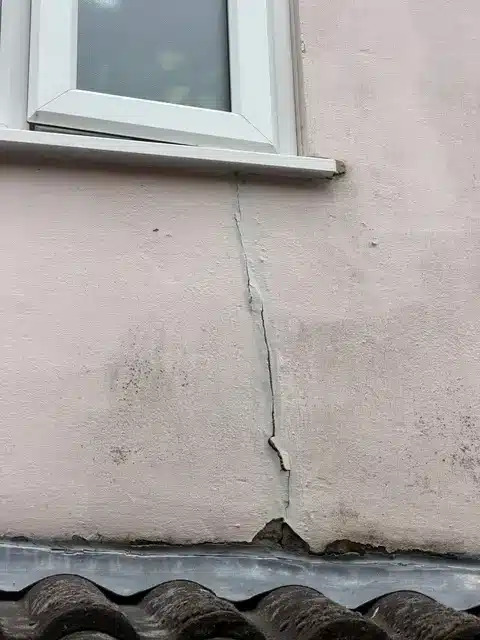
Cracked render works the same way but faster. A crack doesn’t need to be wide to let water through, it just needs to exist, and once water’s behind the render rather than in front of it, it has nowhere to go except further into the wall.
Defective silicone, the sealant around window frames, door frames, and junctions like a conservatory abutment, fails quietly. It’s rarely obvious from the ground, but a gap that’s opened up in a sealant line is exactly the kind of small, easily missed defect that lets water track in at a joint rather than through the main wall surface.
Poor flashing is the one most people have actually heard of, usually because a roofer’s mentioned it at some point. It’s the lead or mortar seal wherever two different roof surfaces or materials meet, and it fails more often than the wall or roof surface either side of it.
Any one of these on its own is enough to cause an internal damp problem. What they all have in common is that none of them get fixed by anything done to the inside of the property.
A Southampton Property With Two of These Problems
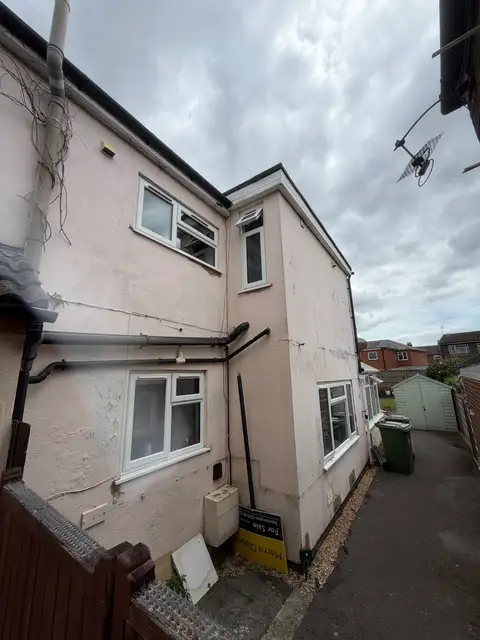
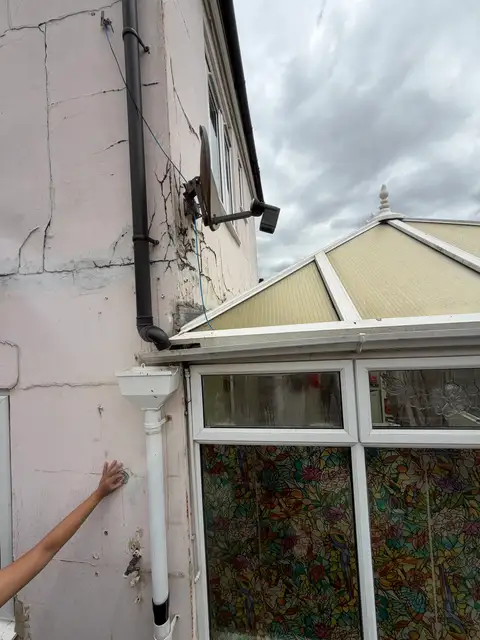
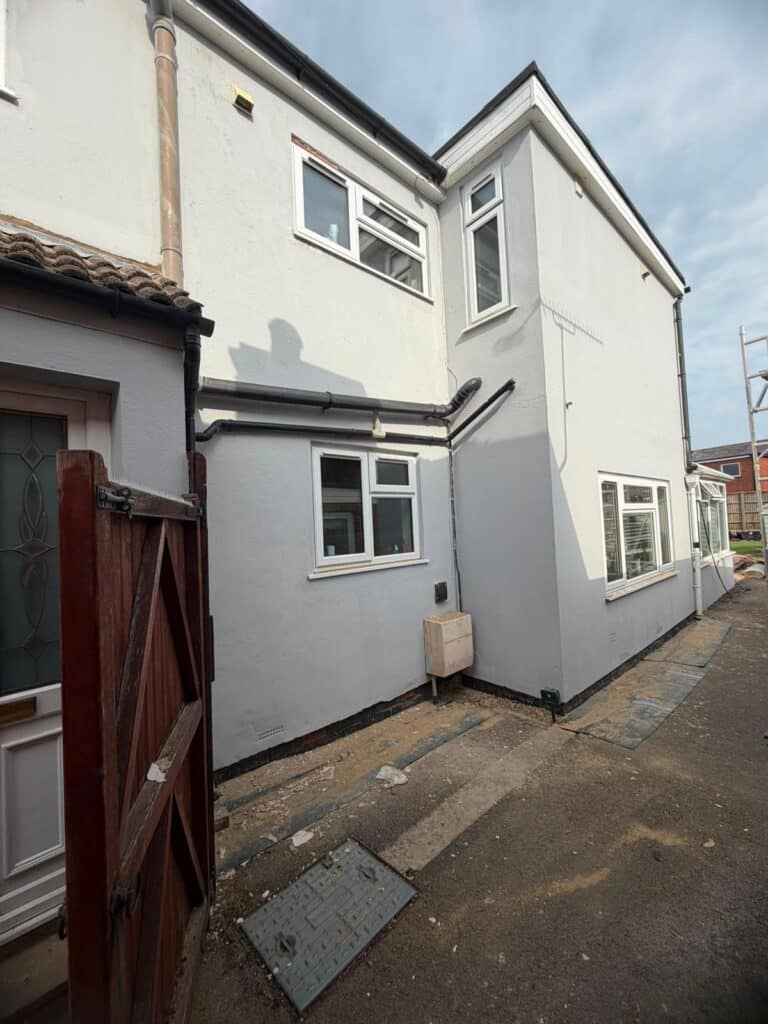
This property had flaking paint and cracked render across its external elevations, and poor flashing at the point where the conservatory roof meets the main house. The paint and render were letting water into the masonry generally, and the flashing, along with the gully and downpipe next to it, was letting water in specifically at the conservatory junction. Two separate exterior problems, both needing fixing before anything done inside would actually last.
Exterior Prep and the RENOTEC Coating
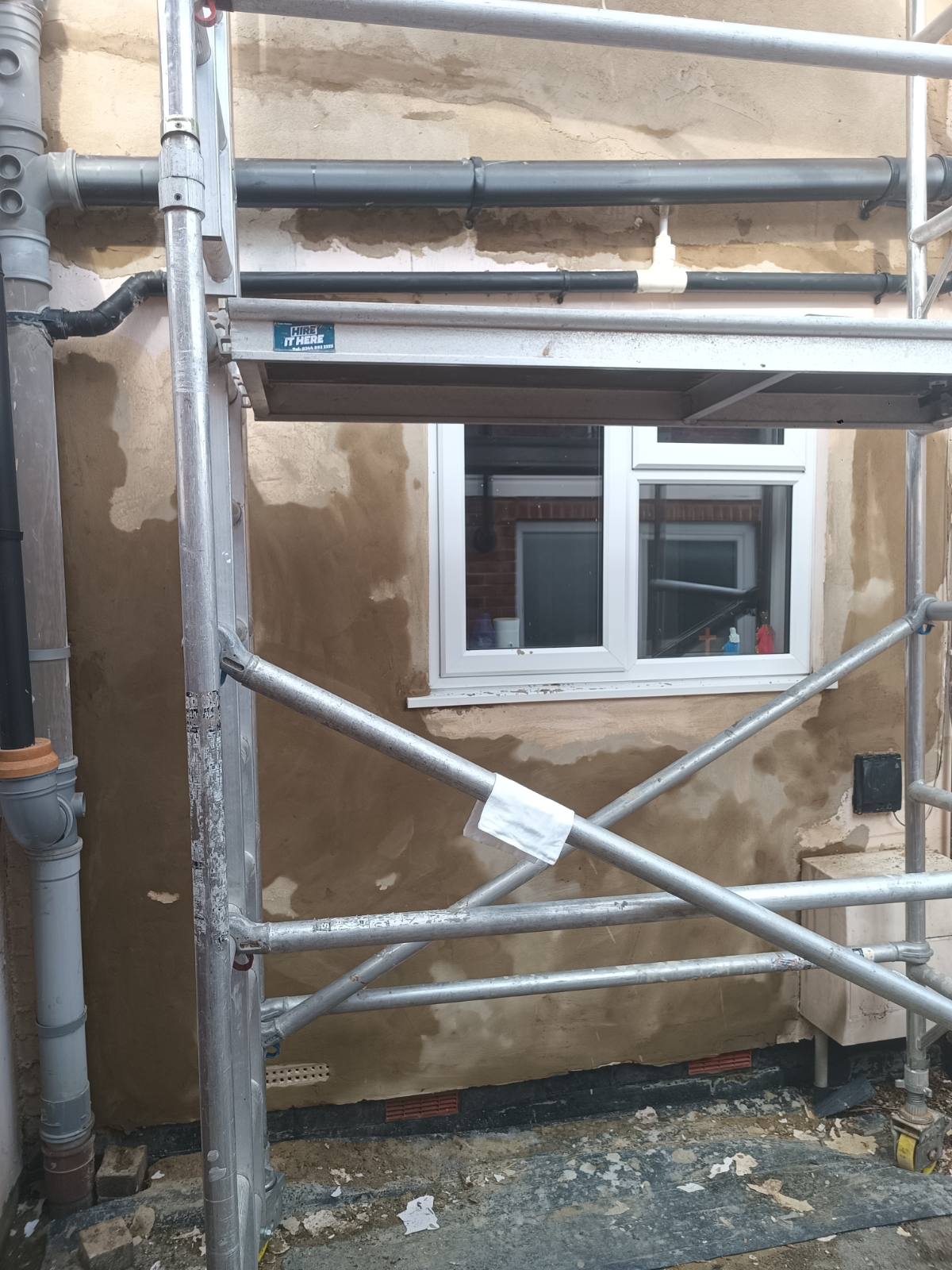
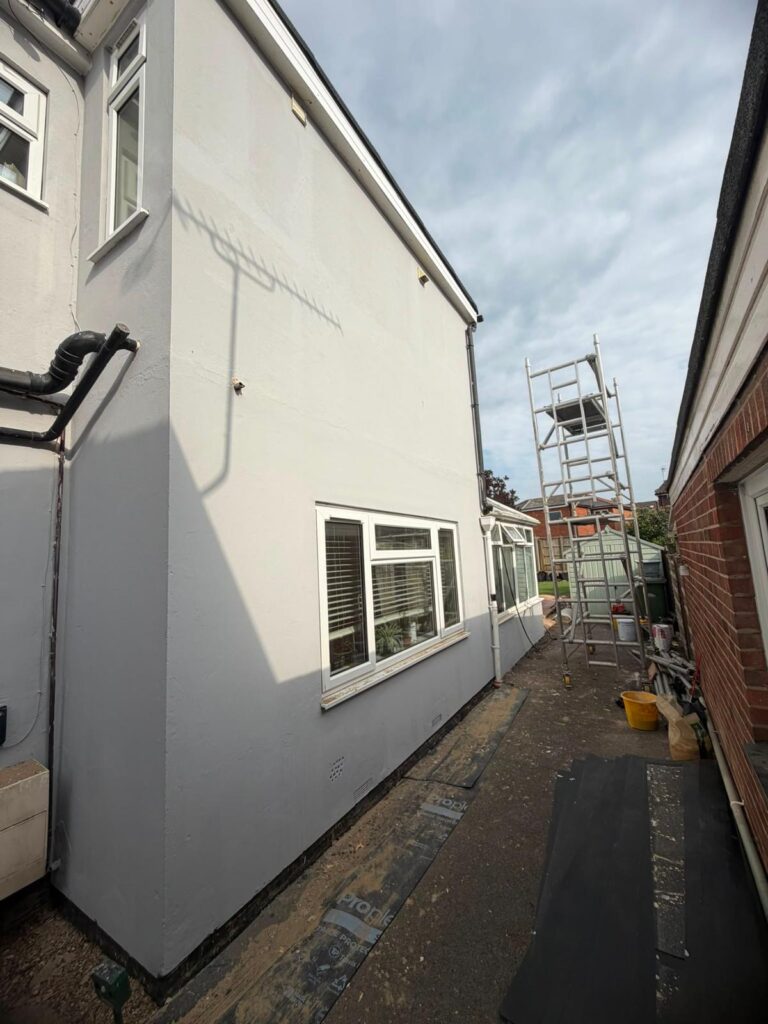
Getting the exterior right meant starting with everything that was already failing. All external elevations were prepared by removing the loose and flaking paint, along with any redundant fixtures no longer in use, then sanding, wire brushing, and pressure washing the full surface. A specialist biocide treatment followed, dealing with any algae or organic growth before it could get sealed in under a new coating. Defective masonry, including the cracked sections, was then patch repaired, since a coating is only as good as what’s underneath it.
Once the surface was properly prepared, a RENOTEC breathable, water-repellent coating was applied across all elevations in a like-for-like colour. Being breathable matters here specifically, it protects against ongoing weather damage while still letting any existing moisture in the masonry escape outward, rather than sealing it in behind an impermeable layer, which is exactly the kind of coating failure that tends to bring back the same flaking problem later.
Fixing the flashing, Gully and Downpipe at the Conservatory
The second exterior problem was at the junction where the conservatory roof meets the house, a detail we see fail regularly on older Southampton properties with a similar layout. The defective lead flashing was removed and replaced, the adjoining gully was repaired, and the rainwater downpipe was reinstated. Together, these repairs close off the routes water had been getting in through and make sure rainwater discharges correctly away from the building rather than tracking down into the junction.
Repairing the Damage Already Done Inside
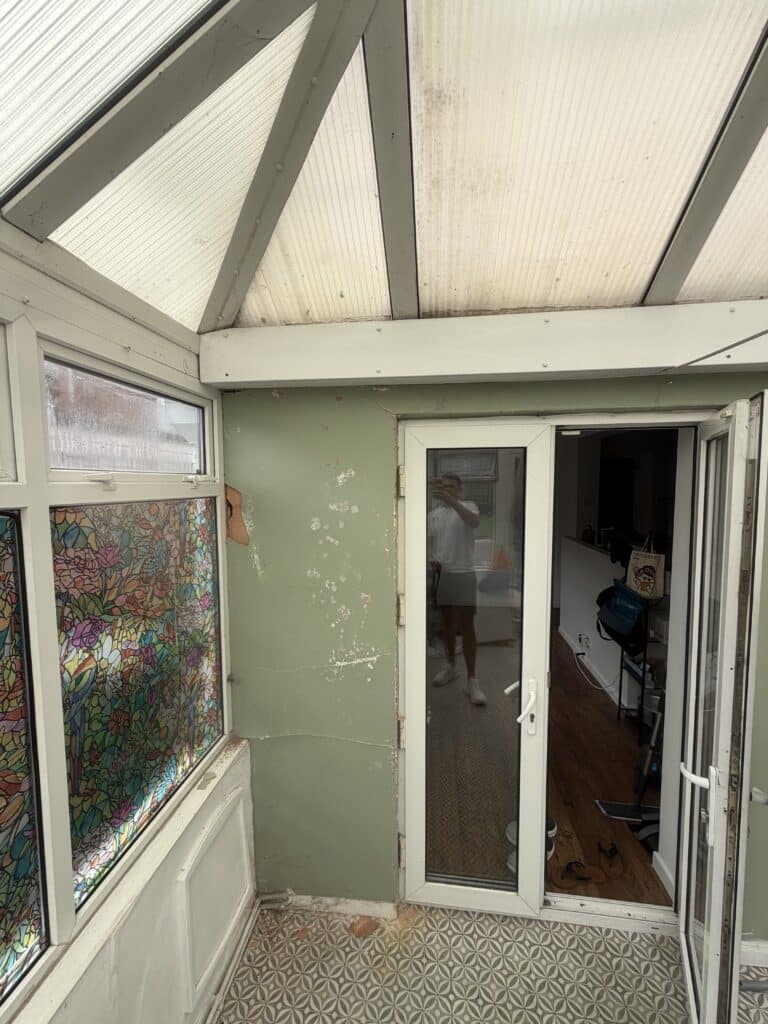
Because this particular leak had been running for a while before it was found, it had already left the internal plaster on the conservatory wall damp-affected and carrying salt contamination. That plaster was removed and the masonry substrate prepared, a salt inhibitor and masonry stabiliser applied, a C3 damp-proof membrane installed, and the wall overboarded using specialist adhesive systems and finished with a smooth plaster surface. This is our standard Proofterior Dry System process, and it’s worth being clear about why it comes last: none of it would hold if the flashing above it was still letting water in.
Why the Order Matters
This is really the whole point. Internal damp treatment, however well it’s done, is only ever addressing where the water ended up, not where it got in. If the exterior is still flaking, still cracked, or still poorly flashed, water finds a way back in and the same internal problem follows it. Fixing the exterior first isn’t an extra step alongside the damp treatment, it’s what makes the damp treatment actually permanent rather than temporary.
The whole job, exterior coating and internal repair alike, is backed by Proofterior’s standard 25-year guarantee.
Frequently Asked Questions
Can flaking paint or cracked render really cause damp on its own, without a leak?
Yes. Neither needs an obvious leak behind it. Exposed masonry from flaking paint, or a crack in render, lets rainwater in gradually every time it rains, which is often mistaken for rising damp or condensation because there’s no single dramatic cause to point to.
Why fix the exterior if the damp is showing up inside?
Because the exterior is almost always where the water actually got in. Treating the internal wall without addressing flaking paint, cracked render, failed sealant, or poor flashing outside just means the same damp returns once the new plaster’s dry.
Does this kind of exterior neglect fall under Awaab's Law if I'm a landlord?
It can. Flaking paint, cracked render, and poor flashing are exactly the sort of root causes Awaab’s Law expects a landlord to investigate and fix, not just paper over with an internal repaint. A hazard that keeps returning because the exterior cause was never addressed is unlikely to satisfy the requirement to resolve it properly within the legal timescales.
Do you check for these exterior problems as part of a normal damp survey?
Yes. A proper damp survey looks at the exterior causes, paint condition, render, sealant, and flashing, not just the internal symptom, since treating the inside without checking the outside is exactly how a damp problem ends up recurring. We cover this across Southampton, including the SO15 postcode area, as part of our wider coverage of Dorset, Hampshire, and Wiltshire.
Is RENOTEC only used on roofs?
Its most established use on our own site so far has been on roof tiles, where it’s applied to ageing but structurally sound coverings. The same breathable, water-repellent principle was applied here to the exterior walls instead, protecting the masonry while still letting existing moisture escape, though it’s worth knowing this wall application is newer than the roofing use case and doesn’t yet have its own dedicated page.